Total Pageviews

Nov 13, 2010

Becoming a Topographicalist

Cold Creek Bog photo by BarrytheBirder

A few days ago, I thanked my sister Diane for her part in helping me to get over a recent rough patch in my life. I noted how her encouragement had got me back to blogging regularly. She subsequently commented that my blog-writing reminded her of the 20th/21st century writer Annie Dillard (Pilgrim at Tinker Creek) but "without the hysteria". She also referred to a Thoreau quote about seeing nature clearly. Henry David Thoreau (Walden, or Life in the Woods), along with his mentor Ralph Waldo Emerson (Nature), were two key figures of the Transcendentalism movement in America in the mid-1830s. Annie Dillard has been described as an ecotheologist, among many other things, and someone who would likely have fasicinating chats with Emerson and Thoreau, were they alive today.
Thinking about the references my sister mentioned, made me ask myself what I was really trying to do with my BarrytheBirder blogspot. I am not a transcendentalist, nor am I an enviromemtal ethicist. But I have always loved maps, especially topographical maps. I love to have a topographical map nearby as I stumble about the countryside. I am intrigued with how places, buildings and natural features that appear on a sheet of paper or in a photo come alive, as I walk along and experience the real thing. I become an explorer and love to note what others might not notice. It is a simple pursuit and serves no truly useful purpose, but I feel at one with the world around me, and am sometimes inspired to share the simple wonders with others. This interest in topography and stepping out to embrace the landforms, the waterways and creature encounters makes me what I have decided to call a Topographicalist. I will continue to be a birdwatcher, a wine-lover, a writer of haikus and a doting grandfather, but for the near future, when asked what I do, I will say I am a Topographicalist. It will be amusing to see if it starts or stalls conversations.

Please comment if you wish.

BtheB

Nov 12, 2010

More Wild Turkeys

Photo by BarrytheBirder

I photographed these Wild Turkeys in the Town of Vaughan today, on the the northern outskirts of Toronto, as they gleaned leftovers from a recently harvested grain field. There were approximately 30 of these very attractive birds in a flock that has survived the fall hunting season in Ontario. All they have to do now is get through a long, cold, snowy Ontario winter. And it seems the wild turkey is remarkably able to do just that. Since a few hundred of them were introduced to Ontario, from the United States back in the mid-1980s, they now number around 80,000 in the southern part of the province. Almost 10,000 Wild Turkeys were killed in Ontario by licensed hunters in 2009. Most were killed with ordinary shotguns, but a few were brought down by muzzle-loading shotguns, bows and crossbows. There are many rules and regulations about hunting Wild Turkeys, all supposedly designed to sustain some sort of natural balance to the new bird population in our province. Inserted into all of the info and data is the following question: "WHY IS BIODIVERSITY IMPORTANT?" The printed answer is as follows: "Biodiversity is all about being connected ... all species, including humans, are dependent on one another to survive". This would seem to presume that dead turkeys are an essential part of the food chain in which human beings participate. Lucky for us that turkeys aren't licensed to shoot. For the record, there is no hunting for turkeys allowed in Vaughan, but there is immediately north in King Township where I live.
Please comment if you wish.
BtheB

Nov 10, 2010

American Coots at Seneca College

Eight American Coots (adults and juveniles) showed up on Lake Jonda today and mixed in with the usual Mallards, Canada Geese and Ring-billed Gulls. They will be heading south of the Great Lakes soon to spend the winter on open water, in places like Virginia, the Carolinas, Kentucky, Tennessee and right on down to northern Florida. But with global warming, it's seems that American Coots are not going as far south as they once did and we will probably see them as year-around residents in Lake Ontario and Lake Erie environs, in a few years. I couldn't get close enough to the coots today to photograph them, so have included a photo of a watercolour sketch I painted almost 20 years ago of an American Coot in a notebook from a canoe trip I made on the Current River in Missouri. If you are not familiar with this bird, it is duck-like, about 13-16" long and its big feet are lobed - not webbed. Oh, and they are omnivorous and will eat just about anything on land or in the water. Alas, coots themselves sometimes show up in Cajun cuisine.


Sketch by BarrytheBirder

Please comment if you wish.

Nottawasaga Bluffs / Mulmur Hills

Wind turbine protest

Wild Turkeys at Mansfield

Contrapositive moss and snow
Photos by BarrytheBirder

Nov 9, 2010

Images and haikus

a pale yellow barn
defies november's crispness
I think warm custard
milkweed pods unlock
legions of seeds fly off on
white silk parachutes

Photos and haikus by BarrytheBirder

Nov 8, 2010

Tamarack Time

Tamaracks at Kettleby

Tamaracks in Cold Creek Conservation Area
Photos by BarrytheBirder
It's November and the last splash of colour in the forests comes from the Tamarack (American Larch). It's always a wonderful contrast against the dark green of other conifers. The Tamarack is a deciduous conifer that loses its needles in the winter and there are people who feel the special green colour of its spring needles rivals that of its autumn gold ones. Tamarack can be found across eastern Canada and are prevalent along the Oak Ridges Moraine, here in King Township, Ontario. Lucky us.
Please comment if you wish.
BtheB

Nov 7, 2010

White-breasted Nuthatch

Photo by BarrytheBirder
Sometimes you have to give it all you've got, to get that tiny tasty morsel.

Nov 3, 2010

Red Squirrel for Thanksgiving

Photo by BarrytheBirder

No, no, this is not about eating Red Squirrel for Thanksgiving. It's about coping with a Red Squirrel at a time for giving thanks. My sister-in-law, Margaret Asbury, regaled everyone at Thanksgiving dinner with the following tale. One day just before Thanksgiving, here in Canada, Margaret's husband, Richard, went out to start their infrequently-used truck. It would start but not keep running. After a few frustrating minutes, Richard checked under the hood. The entire engine compartment was full of Black Walnuts from nearby trees. They were packed in tightly. Richard and Marg cleaned out about 40 of the nuts but the truck still wasn't working. Further searching revealed another 20 or more nuts packed under the pad in the top of hood. Also the pad had been stripped and part of it had been used to create a wonderful nest. They also found a wire had been chewed, which they speculated was in the way of this whole project.
They proceeded to call the CAA. The Canadian Automobile Association service person put the chewed wire back together but the truck still would not run. The truck was towed into town to a mechanic who said that even though the wire was attached, the computer settings were messed up. $250 later, the truck was finally running. Back home there was a little Red Squirrel running around in a panic about his missing walnut stash. Richard was mad, but Marg felt sorry for the squirrel. She thinks the squirrel thought it was set for the winter.
Now the Asburys don't go anywhere in the truck without checking under the hood. Ironically, Marg had just bought a winter's supply of peanuts to feed to the squirrels, which she still says are a joy to watch. So that's the Asbury's squirrel story for this year. It was just a few years ago that a squirrel chewed the gas tank in the Asbury's garden tractor. They're still trying to figure out what the attraction was there.
Please comment if you wish.
BtheB

Nov 2, 2010

70,000 Snow Geese at Delta, B.C.

The above photo of Lesser Snow Geese, filling the sky at Delta, British Columbia, was taken by Don Flucker. Don mentions in an email that the over-wintering population of Lesser Snow Geese at Delta now numbers 70,000. That's double the number of 25 years ago. These geese normally summer on Russia's Wrangel Island. Other Snow Geese migrate further south than the Delta population and spend their winters as far south as California. The total population of North American Snow Geese, including sub-species Lesser, Greater, and Ross's, is now between 5 and 6 million, making Snow Geese the most abundant of all geese in North America. While this number has been skyrocketing over the last several decades, learned opinion says that the numbers are only just approaching historical levels. Others say that the current levels are unsustainable for many reasons and drastic control measures are required. Habitat destruction by Greater Snow Geese around James and Hudson Bays are often cited as evidence for remedial intervention by humans. We seem to totally ignore the fact that the history of animal population (including Snow Geese) on this planet has always been subject to dynamic ebbs and flows. We are not content to accept that the world can exist and survive without human interference. How presumptuous and pathetic. Here in southern Canada, we are amazed at the population explosion of Canada Geese, but that is nothing compared to Snow Geese numbers elsewhere in the country. My youngest sister, Denise, lives in Wemindji, Quebec, a Cree Indian village about halfway up the eastern side of James Bay. Snow Geese were once a part of the native diet in Wemindji, but as mentioned above, Snow Geese have degraded the shorelines of large parts of James and Hudson Bays to the extent that the geese now bypass those waters and don't stop-over on their southern migrations until they they reach places like Canada's southern prairies and the northern American states. Moreover, Denise says Cree goose hunters prefer the taste of Canada Goose. The Cree also shoot a large version of the Canada Goose, which they call the Long-necked Goose, but it is falling out of favour because it is not as tasty as the regular Canada Goose and it is harder to pluck. I guess that's the end of today's class.
Please comment if you wish.
BtheB It's not all Snow Geese out in Delta, B.C. Don Flucker also sent this photograph of a male Wood Duck at a backyard bird feeder. I've seen lots of Wood Ducks over the years, but this first one I've ever seen at a feeder. Great photo, Don.

My weekly hikes with Pieter

My good friend and weekly hiking companion, Pieter Thoenes, took this photograph today of me being thanked by Daisy the Greeter for lunching at the Pine Farms Apple Orchard Cafe, just north of King City. Earlier in the morning , Pieter and I had hiked around Bond Lake in Richmond Hill and then hiked from the Augustinian Monastery at Marylake, just north of King City, up to Pine Farms on the Oak Ridges Moraine Trail. Pieter is a born and bred Englishman, with a Dutch name, who has travelled and lived in many places around the world, but who has a special affinity for South Africa and has called Canada home for decades. Needless to say, he always has an interesting story to tell. That's him below struggling over a stile on our hike today. Next week's hike will be in Pieter's bailiwick of the Mulmer Hills.

Please comment if you wish.
BtheB

Nov 1, 2010

Framed landscapes at Cold Creek

Photo by BarrytheBirder
The old trap-shooting range at Cold Creek Conservation Area, in King Township, has long ceased to exist as a functioning sporting facility. The high plank fence that surrounds its southern perimeter is still standing, but many of the planks have been cut and removed for other uses at Cold Creek, such as boardwalks. The affect is what appears to be very large picture frames with the meadows and hills and trees in the background seen as large artistic landscapes. The effect is quite remarkable and gives a whole new perspective to this part of Cold Creek's walking trails.
Please comment if you wish.
BtheB

Oct 31, 2010

Hallowe'en 2010

Photo by BarrytheBirder
Apparition at Nobleton
Click on photo to enlarge, if you dare

Oct 30, 2010

Top 10 reasons
for why I like to rake leaves
1.
2.
3.
4
5.
6.
7.
8.
9.
10.
C'mon, cut me some slack. I've been doing it for over 60 years. Have a great day.
BtheB

Oct 27, 2010

Tufted Titmouse at Bolton

Wikipedia photo by Ken Thomas
Dave Milsom of Bolton (see previous blog entry below) emailed to acknowledge my mention of his bird sightings at Cold Creek and to say that he has also seen, in the last few days, a Tufted Titmouse at his backyard feeders and four Cattle Egrets at an industrial area near Bolton. I responded to Dave that I had only ever seen a Tufted Titmouse once in my backyard. It was Christmas Day, 1990, 20 years ago less a couple of months. As for the Cattle Egrets, they are becoming more and more frequent in Ontario. Here they are, still hanging about, and we had snow just a few kilometres north of here, a couple of days ago. Global warming's effects are becoming especially evident in the number of bird species that were once rarities in Ontario and are now widespread and seen frequently.
Please comment if you wish.
BtheB

Oct 26, 2010

Lincoln's Sparrow at Cold Creek

Wikipedia Photo by Terry Sohl
Dave Milsom, intrepid birder from Bolton, Ontario, has just added Lincoln's Sparrow (Melospiza lincolnii) to the Cold Creek Conservation Area's bird checklist. It brings the list's total to 122 species. Dave saw two Lincoln's Sparrows on October 25th, along with Golden and Ruby-crowned Kinglets, American Tree Sparrows, a Sharp-shinned Hawk, a Northern Harrier and numerous Grackles and Red-wing-Blackbirds. The Lincoln's Sparrow was not named for Abraham Lincoln. This wee skulker, which has been described as being afraid of its own shadow, was named by James Audubon after his friend, Thomas Lincoln, of Dennysville, Maine. Lincoln shot the bird on a trip with Audubon to Nova Scotia in 1834, and Audubon named it "Tom's Finch" in his honor. Mercifully, cameras have replaced shotguns in the interim.
Please comment if you wish.
BtheB

Oct 25, 2010

Fall's last bright colours

Oct. 25 ~ Ontario's Municipal Election Day

Hallowe'en doggerel


If I should be buried before I am dead,
let my marker read as follows:

Barry D'Alive

Oct 24, 2010

Branta canadensis


Once, maybe twice, I've pictured a Canada Goose in this Blog space. Our Canada Goose is so ubiquitous that one is reluctant to show one more image than is absolutely necessary. I suppose there are those who would say they never get tired of seeing the Canada Goose, either on-the-wing or in pictures. Nevertheless, I believe this photograph captures this bird as well as any I have ever seen. It was taken in 2006 at the Inglewood Bird Sanctuary, in Calgary, Alberta, by Chuck Szmurlo. It appears in Wikipedia's List of the birds of Ontario. This goose with the pale breast, beautifully captured here, appears to be of the subspecies hutchinsii and is common in central and western Canada. Canada Geese normally max-out, in size, at around 114 cm. (45") long, with a wingspan of about 180 cm. (71"). Wikipdedia declares that: " An exceptionally large male of the race B.c. maxima, the 'giant Canada goose' (which rarely exceed 8 kg/18lb), weighed 10.9 kg (24 pounds) and had a wingspan of 2.24 m (88 inches)...this specimen is the largest wild goose ever recorded of any species". Anyway, enough said. My purpose here was to show Chuck Szmurlo's perfect photo of a big beautiful bird. Click on the image for a larger view.
Please comment if you wish.
BtheB

Oct 23, 2010

I wish I'd said this...


God forbid that I should go to a heaven
in which there are no horses
Robert Bontine Cunninghame-Graham 1852-1936

Ozark Trail Association Photo

Photo by Daniel, Fordland, Missouri

As I searched for a photo to illustrate the Cunninghame-Graham quote, above, I recalled a herd of wild horses I'd briefly glimpsed on a canoe trip, along the Current River in Missouri, almost 20 years ago. Long-time friend, Peter Marsh, had organized a gang of good ol' Ontario boys to spend a week paddling across and down the Ozark Plateau from Cedargrove to Van Buren. As our 12-canoe flotilla paddled past the point where the Jack Forks River merges with the Current, I saw a band of wild white horses stampeding along the shoreline and off into the woods. It was a fleeting moment and I wondered if I hadn't seen the ghosts of horses, instead of the real thing. Later, a local Missouran told me I had been lucky to get the glimpse I did and that there were people who had lived all there lives in the area and had never seen them. Sadly, I never got my camera out in time. Now, these many years later, I Googled 'Missouri Wild Horses'. It turns out these horses have been around for a hundred years and in that same year as my canoe trip (1992), the National Park Service was given permission to remove these nuisance horses from their federal land. Apparently, all hell broke loose and following action by good Ozark citizens, the Missouri Wild Horse League was formed and fought a 5-year battle to protect these horses in their home environment. President Clinton signed a bill in 1996 that declared the horses part of the Ozark National Scenic Riverways. Today, the horses are thriving, and in the interests of maintaining a healthy balance in this situation, extra stallions are gelded and put up for sale occasionally, to a lucky few. I'll never forget my lucky glimpse at the last wild horses of the American mid-west.

Please comment if you wish.

BtheB

Oct 22, 2010

Furtive feeder

BarrytheBirderPhoto
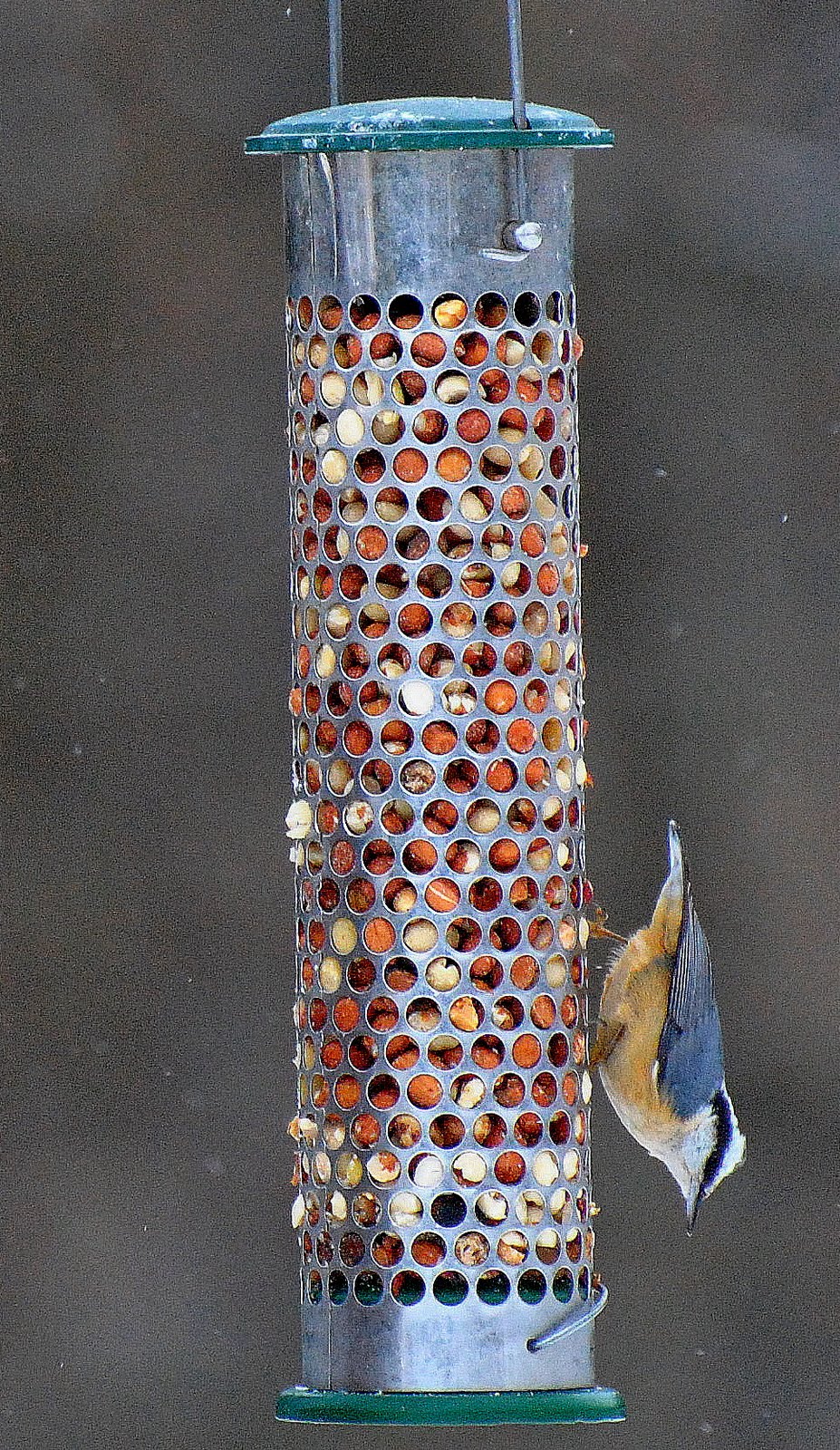
Oh furtive Red-breasted Nuthatch
Streaking in for seedy snacks
Always retreating - never attacks
Oh furtive Red-breasted Nuthatch