Total Pageviews

Nov 1, 2010

Framed landscapes at Cold Creek

Photo by BarrytheBirder
The old trap-shooting range at Cold Creek Conservation Area, in King Township, has long ceased to exist as a functioning sporting facility. The high plank fence that surrounds its southern perimeter is still standing, but many of the planks have been cut and removed for other uses at Cold Creek, such as boardwalks. The affect is what appears to be very large picture frames with the meadows and hills and trees in the background seen as large artistic landscapes. The effect is quite remarkable and gives a whole new perspective to this part of Cold Creek's walking trails.
Please comment if you wish.
BtheB

Oct 31, 2010

Hallowe'en 2010

Photo by BarrytheBirder
Apparition at Nobleton
Click on photo to enlarge, if you dare

Oct 30, 2010

Top 10 reasons
for why I like to rake leaves
1.
2.
3.
4
5.
6.
7.
8.
9.
10.
C'mon, cut me some slack. I've been doing it for over 60 years. Have a great day.
BtheB

Oct 27, 2010

Tufted Titmouse at Bolton

Wikipedia photo by Ken Thomas
Dave Milsom of Bolton (see previous blog entry below) emailed to acknowledge my mention of his bird sightings at Cold Creek and to say that he has also seen, in the last few days, a Tufted Titmouse at his backyard feeders and four Cattle Egrets at an industrial area near Bolton. I responded to Dave that I had only ever seen a Tufted Titmouse once in my backyard. It was Christmas Day, 1990, 20 years ago less a couple of months. As for the Cattle Egrets, they are becoming more and more frequent in Ontario. Here they are, still hanging about, and we had snow just a few kilometres north of here, a couple of days ago. Global warming's effects are becoming especially evident in the number of bird species that were once rarities in Ontario and are now widespread and seen frequently.
Please comment if you wish.
BtheB

Oct 26, 2010

Lincoln's Sparrow at Cold Creek

Wikipedia Photo by Terry Sohl
Dave Milsom, intrepid birder from Bolton, Ontario, has just added Lincoln's Sparrow (Melospiza lincolnii) to the Cold Creek Conservation Area's bird checklist. It brings the list's total to 122 species. Dave saw two Lincoln's Sparrows on October 25th, along with Golden and Ruby-crowned Kinglets, American Tree Sparrows, a Sharp-shinned Hawk, a Northern Harrier and numerous Grackles and Red-wing-Blackbirds. The Lincoln's Sparrow was not named for Abraham Lincoln. This wee skulker, which has been described as being afraid of its own shadow, was named by James Audubon after his friend, Thomas Lincoln, of Dennysville, Maine. Lincoln shot the bird on a trip with Audubon to Nova Scotia in 1834, and Audubon named it "Tom's Finch" in his honor. Mercifully, cameras have replaced shotguns in the interim.
Please comment if you wish.
BtheB

Oct 25, 2010

Fall's last bright colours

Oct. 25 ~ Ontario's Municipal Election Day

Hallowe'en doggerel


If I should be buried before I am dead,
let my marker read as follows:

Barry D'Alive

Oct 24, 2010

Branta canadensis


Once, maybe twice, I've pictured a Canada Goose in this Blog space. Our Canada Goose is so ubiquitous that one is reluctant to show one more image than is absolutely necessary. I suppose there are those who would say they never get tired of seeing the Canada Goose, either on-the-wing or in pictures. Nevertheless, I believe this photograph captures this bird as well as any I have ever seen. It was taken in 2006 at the Inglewood Bird Sanctuary, in Calgary, Alberta, by Chuck Szmurlo. It appears in Wikipedia's List of the birds of Ontario. This goose with the pale breast, beautifully captured here, appears to be of the subspecies hutchinsii and is common in central and western Canada. Canada Geese normally max-out, in size, at around 114 cm. (45") long, with a wingspan of about 180 cm. (71"). Wikipdedia declares that: " An exceptionally large male of the race B.c. maxima, the 'giant Canada goose' (which rarely exceed 8 kg/18lb), weighed 10.9 kg (24 pounds) and had a wingspan of 2.24 m (88 inches)...this specimen is the largest wild goose ever recorded of any species". Anyway, enough said. My purpose here was to show Chuck Szmurlo's perfect photo of a big beautiful bird. Click on the image for a larger view.
Please comment if you wish.
BtheB

Oct 23, 2010

I wish I'd said this...


God forbid that I should go to a heaven
in which there are no horses
Robert Bontine Cunninghame-Graham 1852-1936

Ozark Trail Association Photo

Photo by Daniel, Fordland, Missouri

As I searched for a photo to illustrate the Cunninghame-Graham quote, above, I recalled a herd of wild horses I'd briefly glimpsed on a canoe trip, along the Current River in Missouri, almost 20 years ago. Long-time friend, Peter Marsh, had organized a gang of good ol' Ontario boys to spend a week paddling across and down the Ozark Plateau from Cedargrove to Van Buren. As our 12-canoe flotilla paddled past the point where the Jack Forks River merges with the Current, I saw a band of wild white horses stampeding along the shoreline and off into the woods. It was a fleeting moment and I wondered if I hadn't seen the ghosts of horses, instead of the real thing. Later, a local Missouran told me I had been lucky to get the glimpse I did and that there were people who had lived all there lives in the area and had never seen them. Sadly, I never got my camera out in time. Now, these many years later, I Googled 'Missouri Wild Horses'. It turns out these horses have been around for a hundred years and in that same year as my canoe trip (1992), the National Park Service was given permission to remove these nuisance horses from their federal land. Apparently, all hell broke loose and following action by good Ozark citizens, the Missouri Wild Horse League was formed and fought a 5-year battle to protect these horses in their home environment. President Clinton signed a bill in 1996 that declared the horses part of the Ozark National Scenic Riverways. Today, the horses are thriving, and in the interests of maintaining a healthy balance in this situation, extra stallions are gelded and put up for sale occasionally, to a lucky few. I'll never forget my lucky glimpse at the last wild horses of the American mid-west.

Please comment if you wish.

BtheB

Oct 22, 2010

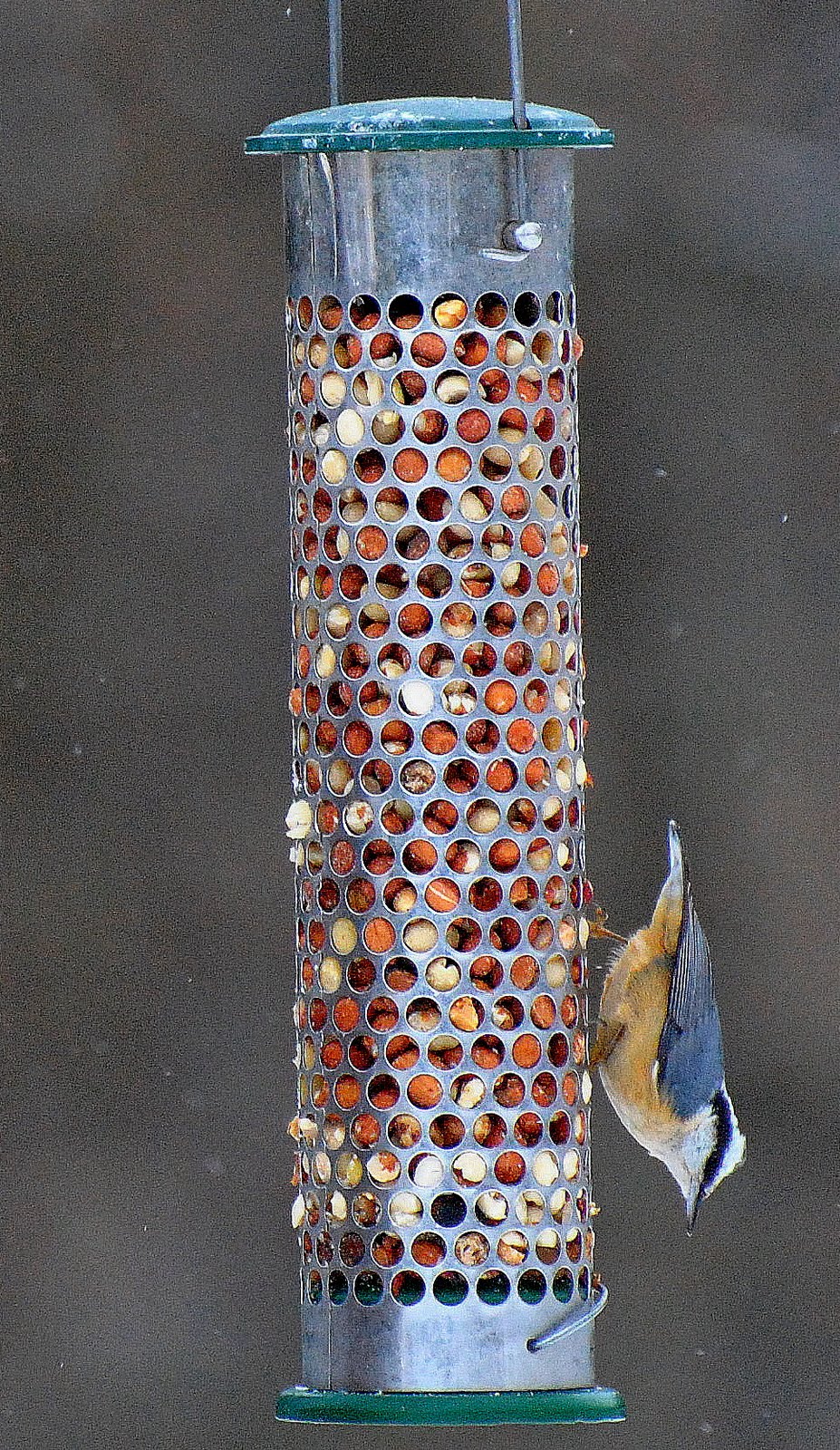
Furtive feeder

BarrytheBirderPhoto
Oh furtive Red-breasted Nuthatch
Streaking in for seedy snacks
Always retreating - never attacks
Oh furtive Red-breasted Nuthatch

Oct 18, 2010

I wish I'd said this...

Ink runs from the corners of my mouth.
There is no happiness like mine.
I have been eating poetry
Mark Strand, Eating Poetry (1969)

Oct 17, 2010

Sitting pretty

Like a small gray
coffee pot
sits the squirrel
Humbert Wolfe 1885 ~ 1940
BarrytheBirderPhoto

Junco hyemalis

Now summer is gone
Warblers give way to Juncos
Bags of seed await
Male Junco

Female Junco
BarrytheBirderPhotos

Oct 16, 2010

Rebecca Caine revisited

Wikipedia Photo
Linda and I first saw and heard Rebecca Caine in Phantom of the Opera 20 years ago in Toronto. Last night we saw and heard her again in the Richmond Hill Centre for the Performing Arts in a cabaret show called Raising Caine. There were spoken references to her roles in Phantom and Les Miserables next to the likes of Michael Crawford and Colm Wilkinson, but the music of this evening featured other musical theatre and operetta selections. The song-list mattered not, because every note she sang was a jewel. To top it off, we didn't have to drive down into, and back from, the "Big Smoke" (Toronto). We were home in 15 minutes and slept the best we have in weeks.
BtheB

Linda in the leaves

Linda and I ooohed and aaahed our way along a leaf-strewn section of the Oak Ridges Trail at Mary Lake today. Pictured above, Linda is standing on a footbridge over one of the several streams that trickle down from the King Ridge and into Mary Lake, which in turn is drained by a stream that empties into the east branch of the Humber River in King City. Mary Lake is at its picturesque best in autumn. I've rambled this piece of the King Ridge for 55 years and never get tired of its timeless beauty.
BtheB

Oct 13, 2010

Fall visitors flying in


BarrytheBirderPhoto
Here's a female Purple Finch (on the left) which I photographed at my Niger Seed feeders today. She was not warmly received by the ever-so-slightly smaller Goldfinches (on the right) but she held her perch until satisfied. The Great Lakes area is the part of North America that can host Purple Finches year-around. Elsewhere they can be found as far north at James Bay (in summer) and as a far south as the Caribbean's American shoreline. For a few minutes, earlier in the afternoon, a Carolina Wren ate seeds on a nearby platform feeder. By the the time I retrieved my camera from the Jeep, it had vanished. Although I waited for an hour or so for it to return, it did not. The waiting time was not completely wasted as I watched many of those trapped Chilean miners being returned to the surface of the earth, above the San Jose Mine, into the arms of their loved ones. Maybe tomorrow the Carolina Wren will return to my feeders and I will take its picture - stay tuned. As it is, today's sighting was species #72 for my list of backyard birds.
BtheB

Describe this colour if you dare

Here's another Fraser River Delta sunset photo from my old acquaintance, Don Flucker, in Ladner, British Columbia. Don's one of those lucky people who lives on the water - literally. He lives in a floating house and is one of the lucky people in this world who gets two sunsets each evening: one in the sky and one in the water, coming together, becoming one and then vanishing.
BtheB

Oct 12, 2010

Thanksgiving weather ~ you never know

This is my daughter Allison and my grandson Spencer enjoying a Thanksgiving dip in Uncle Patrick and Aunt Beth's pool, in London, Ontario. You just never know at our latitude, in south-central Ontario, what kind of weather to expect at Thanksgiving. I remember long ago returning on a ferry boat from a Thanksgiving celebration on Christian Island, in Georgian Bay. As we ploughed through the cold October waves toward Cedar Point on the mainland, I remember an indian elder looking back saying it looked like snow coming. It was cool and overcast but I couldn't imagine it actually snowing. Twenty minutes later, as we reached the dock, it was snowing heavily. The thing about Thanksgiving is you have to give thanks no matter what, including the weather.
BtheB

Oct 11, 2010

October's last rose

They are not long, the days of wine and roses.
Ernest Dowson, English poet,
who died at the age of 33 (1867~1900)

Oct 9, 2010

Imagine, if you will...

Temagami? Algonquin? Haliburton? Muskoka? I wish. Try Richmond Hill - on the edge of Toronto. I had to settle for the lakeside trail around Bond Lake today for my fall flavours. If there is a better one-to-two-hour walk in southern York Region that makes you feel like you're 200 kms. north of here, then let me know. The trail I'm talking about is not the official Town of Richmond Hill walking trail which skirts around the southern side of Bond Lake, in north Richmond Hill. I'm talking about the unofficial, but well-trodden trail that circles the entire lake at the water's edge. It's easy enough to find, on the east side of Yonge Street (on the big curve), just south of the community of Oak Ridges. My photos above do not do justice to this historic, moraine kettle lake. Extremely tall and mature Oak, Maple, Spruce and Ash soar up the steep slopes that encircle Bond Lake. It's a popular spot, but it is so beguiling in its northern Ontario disguise, that you feel like you're on the infamous 3-mile portage between Lake Opeongo and Dickson Lake in Algonquin Park. On my walk, I saw one of our smallest birds, a Ruby-crowned Kinglet, and one of our largest birds, an Osprey. There was a fellow fishing who told me there were metre-long Pike in the lake. At another spot, a middle-aged couple were sitting in small camp chairs, eating sandwiches and passing a litre of red wine, back and forth between themselves. On top of everything else, the weather was perfect...the kind of day to which Rip Van Winkle succumbed, methought.
Please comment if you wish.
BtheB

Oct 8, 2010

No Nobel ~ but worthy of one

Liu Xiaobo, Chinese dissident and human rights advocate, has just won the 2010 Nobel Peace Prize. Greg Mortenson, of the United States, was a nominee for the same prize. Greg was also a nominee in 2009, but lost out to Barrack Obama. I have just read Greg Mortenson's book, Three Cups of Tea, which describes the years of work he has put into building schools (especially for girls) in Pakistan and Afghanistan. I am late coming to this man's inspiring story.

Greg's book was published in 2006 and became No. 1 on the New York Times Best Seller List. I can't recommend his book highly enough. Three Cups of Tea was co-written by David Oliver Relin and is a compelling and inspiring read. But the book's triumph of story-telling pales in comparison to the brilliant life being lived by Greg Mortenson, the humanitarian. Governments love to talk about humanitarian aid, but here is the gripping tale of how humanitarianism is really about one-on-one sacrifice and service. I sincerely hope you find the time to read this book. You may feel re-born.
BtheB

Sep 29, 2010

Up on the King Ridge today

Disappearing into the woods

Vernal pond hangs on to become an autumnal pool

BarrytheBirderPhotos

The King Ridge is one of my favourite sections of the Oak Ridges Moraine Trail, especially the unopened road allowance between the 6th and 7th Concessions of King Township. As I write this blog, I am co-incidently listening to Willie Nelson's sweet, sweet version of September Song. It talks of the September days dwindling down to a precious few. The next two weeks will be prime time for fall colours during the shorter days of autumn. Get out there and enjoy them while you can. Please comment if you wish.

Sep 27, 2010

This one had me confounded

Bill Salter, a friend who lives on the Oak Ridges Moraine in King Township, sent me the above picture of a bird that crashed into one of his house windows. The bird didn't survive and as Bill prepared to dispose of it, he was puzzled about the identity of the bird and intrigued by the bright pink colouring on its underwings. I too was puzzled and intrigued and sent the picture to fellow King City resident and friend, Gerry Binsfeld. Gerry is one of Canada's best birders and cleared up the mystery for Bill and me. This bird is a 1st fall (juvenile) male, Red-breasted Grosbeak. I have certainly seen Red-breasted Grosbeaks before - but usually the adult male, with its very distinctive black and white and red colouring. I know I've seen females in the company of males, but would be hard-pressed to describe them off the top of my head. Ignoring the large, thick conical bill, its overall size, and its white face markings, I was completely baffled by the underwing colour. Gerry contacted his buddy, Mark Peck, who oversees the ornithology collection at the Royal Ontario Museum. Mark expressed an interest in having this bird (which Bill Salter had put in his freezer) and arrangements have been made to pass it on to Mark for the museum's collection. I was amazed at how a fairly common bird, when see from an uncommon perspective, could confound me so. Not the case with Gerry, though, and that explains why his bird life-list is probably ten times longer than mine, or more.
Please comment if you wish.
BtheB

Sep 21, 2010

Walking into Wilderness


Walking into Wilderness is the title of Heather Robertson's newest book. It is sub-titled The Toronto Carrying Place and Nine Mile Portage and has been published by Heartland Associates, Inc., in Winnipeg, Canada. I have known of Heather for several years (we live in the same village) and have come to know her better in the past couple of years. I was humbled and delighted when Heather asked me to be one the contributing photographers for Walking into Wilderness. A dozen or so of my photographs were eventually used and I feel priviledged to have played a small part in Heather's outstanding recording of Canadian history. The photo above shows Heather at one of the recent, numerous launches for her book; this one at the celebration, in King Township, of the 400th anniversary of the French in Ontario. In the hectic year leading up to the publication of this remarkably researched and deftly written book, Heather found time to battle cancer and is now on the mend. Heather is a prize-winning author for both her fiction and non-fiction books and Walking into Wilderness is another great, literary contribution to the understanding and appreciation of Canadian history. Please call on me again Heather, for any future projects you have in mind. It was great fun.
BtheB

Sep 19, 2010

This one's for the guys

I visited an old friend, Glenn McKinnon, and his wife Joanne, last week. It had been many, many years since we last saw each other. One of the the things Glenn showed me was his collection of motorcycles. Anything with wheels and a motor, and Glenn is in his element. Stored with the bikes was this 1974 International Harvester Cub Cadet garden tractor. We've all seen restored cars, right? Well, I don't know about you, but I've never seen a restored garden tractor. This beauty is 36 years old. It might seem hard to appreciate this restoration in the same way you would a car or a truck or even a motorcycle, but trust me, you just can't help but stand there and say "Well, I'll be damned". This little beauty is special, just like Glenn: a talented guy, indeed.
Please comment if you wish.
BtheB

Cyprinus carpio

My Cambridge Encyclopedia says the carp "...thrives in warm pools, lakes, and rivers with rich vegetation...". That's certainly the environment in which this one greeted me, at Lake Jonda on Seneca College's King Campus this morning. In no time, he (or she) was taking tidbits of vegetation from my hand. Any hope of ever being described as attractive are dashed by those two pairs of barbels on the upper jaw. A friendly enough fish however, and I quite enjoyed our close encounter.
BtheB

Tiny wire jails

My recent encounter with an escaped Zebra Finch got me to wondering about why, of all the creatures in the world that we put into cages, we put birds into the smallest ones. Birds are the one creature that can fly anywhere in the world and yet we put them in tiny wire jails. I suppose a similar case could be made for fish and small glass prisons. But when we think of freedom, we don't usually think of swimming free: we think of flying free. Many caged creatures are part of our food chain and their treatment is often inhumane. But caging birds out of spite, or jealousy, or dominance, or because of a myriad other human foibles, it is unworthy of us; supposedly the most consciously aware and emotionally sensitive of animals. European Goldfinches, like the one below, were once very popular caged birds. In time, the world came to discover and prize the exotic-looking birds of far-off places. In some places laws had to be enacted that stipulated cages had to be large enough to allow a bird to stretch its wings to their full, natural extension. In the USA, it is against the law to cage native species of bird (go figure). And don't get me started on zoos. I won't even take my grandchildren there anymore. Please comment if you wish.
BtheB
Wikipedia Photo

Sep 18, 2010

Unlucky puss

In nature there are neither rewards nor
punishments - there are consequences.
Robert G. Ingersoll, 1876

I took the above picture a few days ago, at the home of my brother Bob and his wife, Nancy, in Parry Sound, Ontario. It shows the simplest of grave-markers. It is also the very spot where one of their pet cats was recently killed by a fisher. The fisher is a 10-to-20-pound predator that is easily capable of killing a cat of the same size. It seems in the Parry Sound area, the Ontario Ministry of the Environment determined that re-locating fishers here was a natural way to control a porcupine population that was wildly out of control. The fisher is one of the few predators that can successfully hunt porcupines. The word in and around Parry Sound is that having reduced the porcupine population to a level that could not sustain its own voracious appetite, the very large weasel is now rapidly reducing the populations of several other wild creatures. Whereas it was once thought that fishers rarely preyed on cats, locals in the Parry Sound area are reporting many slaughters of their cats. This is the second cat that Bob and Nancy have lost in this way. My use of the word slaughter is deliberate, as the fisher is a remarkably efficient and masterful killer, violently tearing its victims from limb to limb and scattering the shreds around and about. The unfolding of nature can be gruesome, as well as pretty. I am usually uneasy, sometimes queasy, when humans presume to re-balance nature. Invariably, we over-react, over-correct, fail to make the world a better place, and misspend a pile of money. Then there's the collateral damage, even if it's just another dear pet. Lord, save us from our own accomplishments.

BtheB

Sep 14, 2010

Purple ponderings

"I think it pisses God off if you walk by the colour purple
in a field somewhere and don't notice it".
-- Alice Walker, from The Color Purple, 1982

Although everywhere is an ocean of goldenrod this September, I did notice these wild asters today at Humber Trails Conservtion Area. Alice Walker, please take note.

Please comment if you wish.

BtheB

Destination: Octopus Islands

My old acquaintance, Don Flucker, an Ontario expatriate now living in lower British Columbia, just sent some photos of his family boating adventures this summer in the Georgia Strait, aboard their 'Chantilly Lace'. Don logged 8oo kilometres this summer and reached Desolation Sound and the Octopus Islands. Below are some of the pictures. I believe any time on the water is a special time, but when you get to do it along B.C.'s Sunshine Coast, it's one of those near-to-paradise times. Best wishes to Don and his family on many more trips.

Sunrise at Comox

Jervis Inlet ~ a Canadian Fjord

Moonglow over Comox
Please comment if you wish
BtheB

Sep 12, 2010

Migrating warblers drop in

Black-throated Green Warbler

Orange-crowned Warbler
Here are two southward-migrating warblers that appeared in the backyard this morning after overnight showers. The Orange-crowned Warbler is a lifer for me: #387. (Click on photos to enlarge).
Please comment if you wish.
BtheB

Sep 10, 2010

Hiking at Cawthra Mulock

My hike today was at the Cawthra Mulock Nature Reserve, just south of the Holland Marsh, in King Township, between Bathurst and Dufferin Streets. The western trailhead on Dufferin Street does not present a visually-promising start: a large weedy meadow flanked by huge hydro towers. 300 metres and 5 minutes in however, things take on a promising aspect. My hikes are usually taken to bring me selfishly close to nature, but today I was keeping in mind the fervent protests of many Ontarians concerning a planned Ontario Hydro installation nearby. The Premier of Ontario has intervened and it seems the project is a go, no matter what. The case for the hydro plant is seemingly well made in that the surrounding countryside here is already host to a large transformer station and major intersecting power lines. On the surface it seems an excellent business case has been made, but sadly, environmental, social and aesthetic considerations fall by the wayside. The trails on this 268-acre site serve their purpose quite well and are deservingly popular. Some of the pictures I took are show below. The nature reserve and its trails will continue to exist, cheek by jowl, with the the hydro towers (new and old). The trick will be to not look over your shoulder.

I sat on a bench and enjoyed the view over a pretty little pond, which has a resident Kingfisher who wouldn't come close enough for a good picture. I'll get him next time.

I found the remains of an ancient farmstead interesting, especially what appeared to be a square silo.
Markers on the main trail are red paint on old wooden posts or white arrows with a red background on metal posts. There are four connecting trails in total.

Butterflies, like this obliging Red Admiral, abounded at Cawthra Mulock Nature Reserve today.

Please comment if you wish.
BtheB

Sep 8, 2010

September turns yellow

It's the time of year when goldenrod takes over from all other wild plants and paints every rural roadside and bit of uncultivated open land with tall tufts of yellow flowers. One moment the countryside is green, then almost overnight everything is yellow. This summer has seen a great growing season and here the goldenrod exceeds its normal maximum height and rises above the fenceposts at Seneca College, on the outskirts of the village of King City. In early September, it's hard to overlook and easy to admire, even on a damp overcast day.

Nearby, on the floor of a wet hardwood forest, Sensitive Fern provides a cool alternative to Seneca's goldenrod. The Sensitive Fern is distinctive from most other ferns, but some observers describe it's large-lobed fronds as coarse. There are other who call it beautiful. I side with the latter. It got its name from its wilting sensitivity to even the slightest, early frosts.

And finally, this afternoon's jaunt to Seneca College ended with a fly-over by a Great Blue Heron. While the lighting did not favour this bird's lovely colour tones, it did accentuate its remarkable profile.
Please comment if you wish.
BtheB

Sep 6, 2010

Zebra Finch in King City?!?!


I was awakened from my afternoon nap by Linda hollering at me to come to the backdoor to "..see this bird!" Lo and behold, the lady of the house had spotted A Zebra Finch in the cedar hedge. Now if Linda and I lived in Australia, this sighting would be no big deal. But in Canada? 15,000 kilometres is a long way to stray. I rushed for my camera, took a dozen quick shots, while babbling like an idiot about Linda's unbelievable sighting. To which she replied: "It must be an escapee." "Oh, well of course", I said, crestfallen. It was the only realistic explanation. Nevertheless, this tiny little bird is spectacular to see. No wonder it is one the most popular cage birds in the entire world. It joined us on the back porch and looked at the Goldfinches and Chickadees at the feeders. It seemed intrigued by their activity. Then it flew into the cedar hedge again and then down to our back steps before moving on. I refuse to speculate on its fate, and will be content with the knowledge that this tiny, fragile and free-flying creature made my heart sing for part of this day. Thank you Linda. I owe you one.
Please comment if you like.
BtheB

Sep 5, 2010

Late summer ~ Marylake


I've been wandering around the grounds of Marylake Shrine & Augustinian Monastery Farm for about 50 years now. I had never, in those 50 years, circumnavigated the lake on foot, until today. There are footpaths the length of the lake, along the east side, but the west side is mature forest and tangled wetlands, and as I discovered, generally passable only to the young and fit. Moreover, it has little to offer compared to the other natural physical areas of this former Sir Henry Pellat estate. But at least I can say I have walked right around Mary Lake. I also took the opportunity to have a look inside (the doors were wide open) of the massive brick barn that always amazes visitors with its size and style. The picture above shows the unusual criss-crossed rafters under the main roof. Sadly the barn is no longer in use and is deteriorating. What was once a thriving dairy farm, operated by numerous monks, is now mainly a religious retreat centre. Marklake is just north of King City, on Keele Street, and the Oak Ridges Moraine hiking trail provides access and great views of the lake and the surrounding fields and forest. Go far enough and you'll wind up at the Pine Farms Orchard on the 16th Sideroad and its charmingly cozy cafe.
Please comment if you wish.

BtheB

Sep 2, 2010

Grampa's 99-year-old corn


My grandfather, Sid Thomas, brought this cob of corn from Wimborne, Dorset, England in 1911. As you can see, some of the kernals are missing. Did Sid nibble on some while crossing the Atlantic? Did mice expropriate their share? Or did Sid plant some of the kernals in the soil of his new homeland, Canada? After 99 years, it seems the right time to plant some of these kernals should be next year, marking the 100th anniversary of the cob in Canada. My sister, Denise, suggests if the planting is successful that she and I, along with our sister, Diane, and brother, Bob, could get together for a corn roast. That would be great, but we do live apart from each other, by a combined distance of 3,700 kilometres. A simpler solution might be to send them some kernals, from King City, for planting in Parry Sound (Ontario), Wemindji (Quebec side of James Bay) and Vernon River (Prince Edward Island). How will this turn out? We'll all have to wait a year to see an outcome. Stay tuned.

BtheB